Baltimore holds the oldest degree-granting art college in the country, a top research university and hospital system, a mature network of community arts organizations and a deep tradition of Black cultural production. It also has high violent crime, tens of thousands of vacant properties and high poverty. In 2025 the city recorded its lowest homicide rate in nearly fifty years, and in the same year a perception-based crime index ranked it the third most dangerous city in the U.S.
The city has invested heavily in revitalization: the Mural Program, the Inner Harbor Plan, the Black Arts District, and a city-owned Hilton built for about $300 million. Many of these work as intended. What goes unmanaged is their symbolic side, what they say about the city, so its strengths stay invisible to visitors and to residents. Following Kavaratzis, a city speaks first through its buildings and behavior; this project starts with one of those buildings.
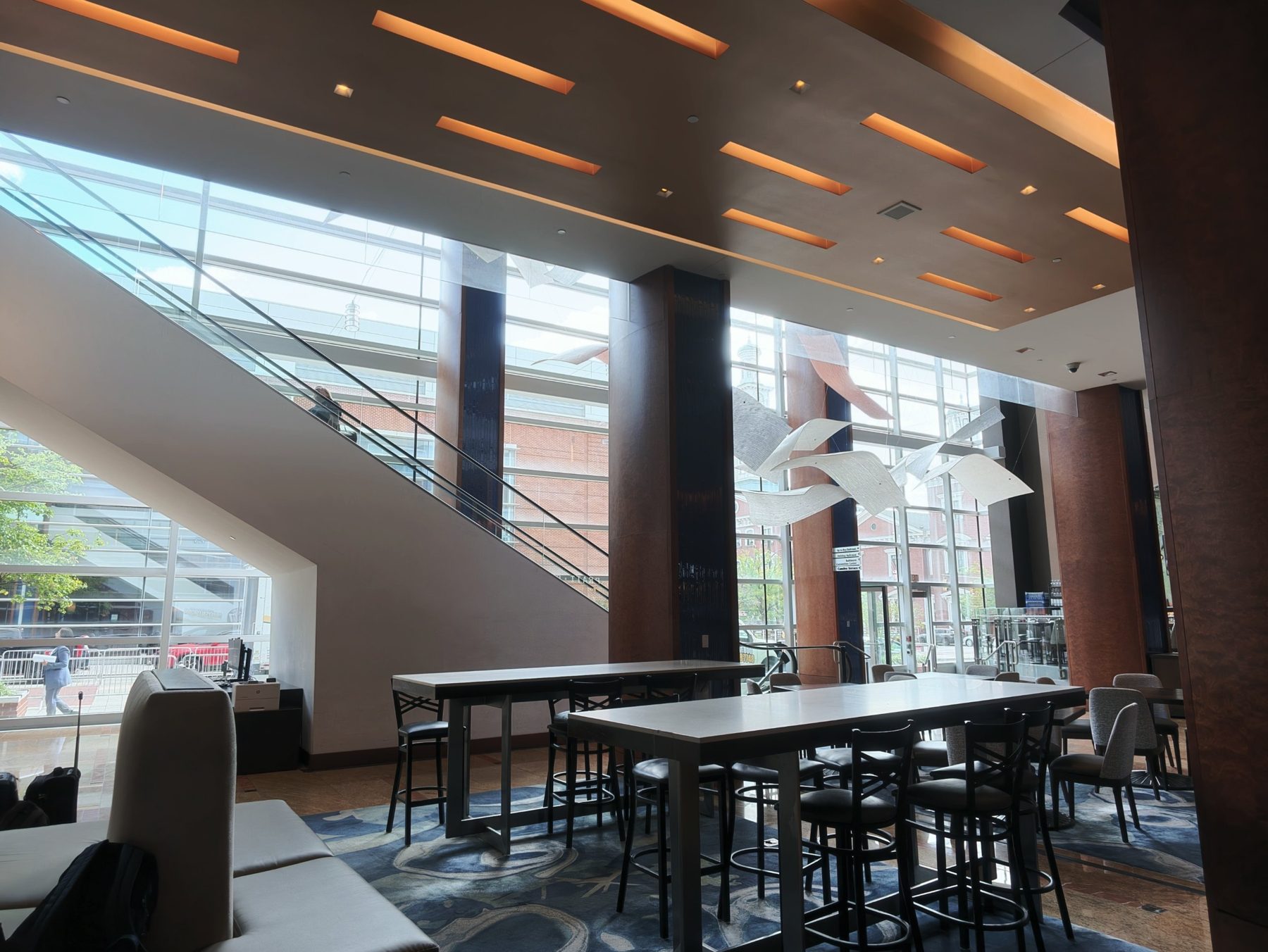
My own observations at the hotel kept pointing the same way. Nothing in the lobby says anything about Baltimore. The lobby restaurant has no local dishes, even though staff said catering is the hotel’s second most profitable service. The gift shop sells local artists’ work with no context about who made it, arranged like a gift shop at a highway rest stop. Online, the hotel’s past workshops with local artists were poorly presented and its social accounts barely managed. The pieces for a Baltimore story are already there; nobody is telling it.
QuestionWhat does a city communicate, or fail to communicate, through a building it owns?
MethodStructured observation with a team codebook (103 coded observations from the first three-hour session). A team synthesis workshop then clustered ideas around one question, how the hotel might give visitors the best impression of Baltimore, into themes such as signage, hotel-to-city, city-to-hotel, lobby experience, accessibility and check-in, and mapped them against a visitor journey. Visitor interviews and on-site design interventions are planned.
Key sources- Kavaratzis (2004), from city marketing to city branding
- Braun, Eshuis & Klijn (2014), the effectiveness of place brand communication
- Ball-Rokeach, Kim & Matei (2001), storytelling neighborhood
- Sanders & Canel (2015), local government communication and citizens’ perceptions
- Goransson & Fagerholm (2018), visual strategic communication
From research to formFrom the shared research, each of us developed our own response. Mine is the Inner Harbor Atlas, an interactive map that turns the hotel into a starting point for the city.