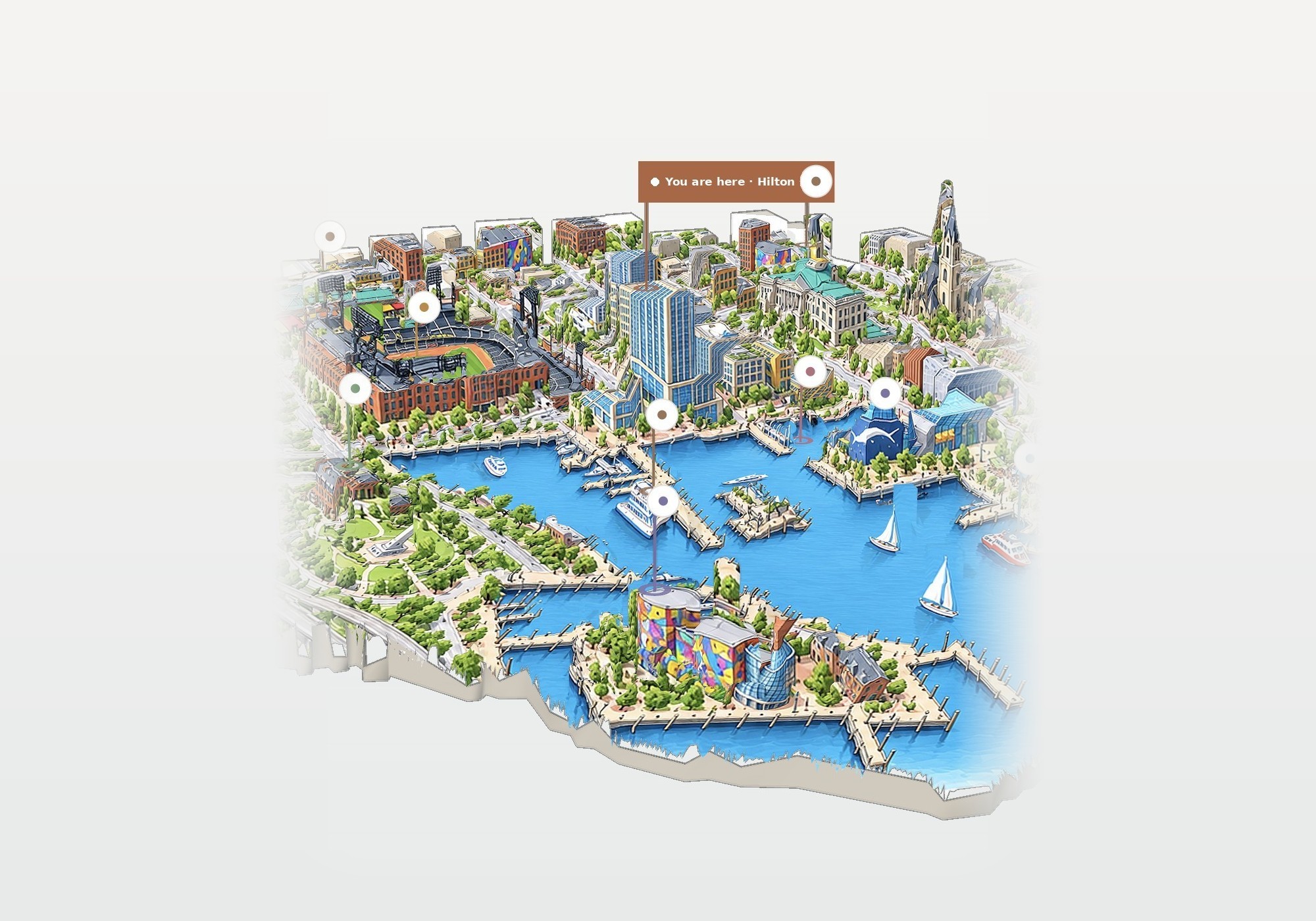
A map that starts in the hotel lobby and hands visitors the city.
Inner Harbor Atlas is an interactive 3D map of downtown Baltimore that starts from the Hilton Baltimore Inner Harbor. Every walking time is measured from the hotel’s front door, so a guest standing in the lobby can see the city as something within reach: the convention center in four minutes, Camden Yards in five, Harborplace in ten, Federal Hill in eighteen.
Eleven places are marked on an illustrated isometric model of the harbor and sorted into waterfront, museums, sports, parks and views, history, and food and shops. Visitors can rotate and zoom the model and tap any marker or building for details. The whole atlas switches between English, Spanish, Chinese, Korean and Japanese.
The proposal places the atlas in the lobby in two ways. QR codes near the front desk let guests open it on their phones while they wait to check in, and take it with them when they head out. A freestanding touchscreen on a rolling stand sits on the lobby floor and runs the same interactive map, so anyone passing through, guest or not, can turn the model with their hands, tap a place and find their way from the hotel into the city. Because it stands on its own, it can move wherever the lobby needs it, without construction. The project is now at the low-fi prototype stage.
Starting with one hotel is a deliberate choice. A screen and a few printed QR codes fit within what the Hilton could realistically spend, and a small first version is easier to test, change and grow. The next step is to extend the atlas from the harbor to the whole of Baltimore, so the same map can move into other hotels, venues and visitor spaces across the city.
The atlas is my own design proposal in response to the Cultural Visibility Gap research. The team fieldwork found that the lobby says almost nothing about the city that owns it; my answer is to give the building a way to point outward, so a guest’s first question, what is there to do here, is met with Baltimore itself.