← Writing · Research notes · Behind The Displaced Realm
Beauty in mass media, 1960 to now
What six decades of advertising and media asked of women in the name of beauty, how each wave of feminism pushed back, and where each one ran into its own limits.
Why I started
The sixty-some years from 1960 to today may be the most changeable stretch in the history of women and media. Mass communication moved from a few centralized channels, run mostly by local institutions and advertisers, to a global internet where ordinary people make most of what we see. Along the way, what counted as “beauty,” and what women were expected to do for it, kept changing.
In 1960s ads, a woman became beautiful to be a better companion to a man. By the 1980s she was supposed to shine at work too. Around 2000, sexualized and objectifying images came back, alongside a backlash against feminism. After about 2013, the message turned again: be beautiful for yourself. Each version shaped how a generation thought about family, marriage and work, and each generation, in turn, pushed the images to change.
Today, nobody needs to organize a letter campaign or march in the street to be heard. Anyone can post. A whole generation of fashion and beauty creators seems to have the microphone. I wanted to know whether that freedom comes with new limits of its own.
These notes follow three waves of feminism (the second, third and fourth) through the way media showed women’s beauty practices. Up to 2000 I look mainly at American media; after 2000, at American and Chinese media. For each period I ask how women responded, how the media changed, and what choices women made about marriage, family and work.
I. 1960s to 1980s: the kitchen and the laundry room
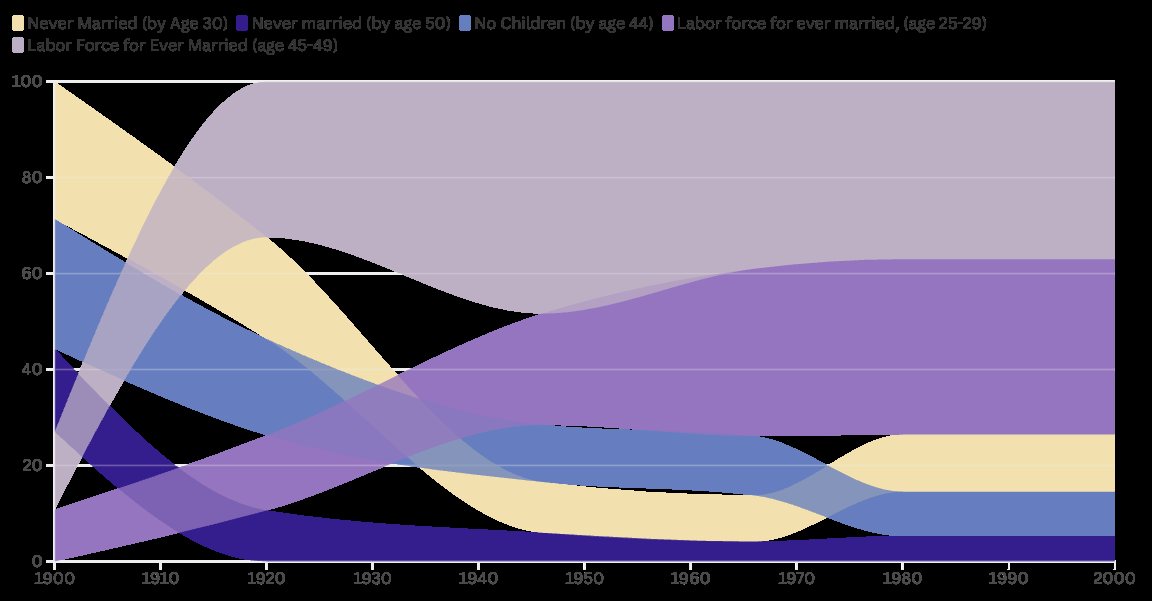
The second wave of feminism in the United States took off partly in response to how advertising objectified women. To see what that meant in people’s lives, I followed three generations of college-educated American women, drawing on Claudia Goldin’s research in Career and Family.
Born 1924 to 1943: family first, then a job
In 1963 these women were between 20 and 40, the age when most people settle family and work. Their lives matched the mainstream image in ads: a white, middle-class woman centered on the home.
- About 90% of women who graduated from college between 1946 and 1964 married.
- Of those, around 12% had divorced twenty years later, and some went on to campaign against unfair divorce laws. By the 1960s, about 29% of this group could not keep a marriage going for twenty years.
- Many gave up careers for family despite their education, and often had very little say at home.
- Some left the home and started earning, Toni Morrison among them. Between 75% and 85% began working in their forties or fifties, and many of those, perhaps 88% to 93%, were Black women or women from other minority groups.
Born 1944 to 1957: career first, then family
In 1963 they were 9 to 20 years old, the age when values form, and most finished college between 1970 and 1980. They grew up during the protests against media stereotypes and watched their mothers live through unhappy marriages. Many chose work first. Their divorce rate was higher, with some 37% unable to keep a marriage for twenty years, and 27% never married.
Born 1958 to 1978: trying to hold both
The oldest were five in 1963, so they grew up entirely inside this era and graduated between 1980 and 2000. About 27% did not marry before 30, more than 80% kept working throughout, and many were willing to use fertility technology to delay having children.
What the ads said
Mass media used the white, middle-class woman to stand for all women. In ads she appeared in two places: the laundry room and the kitchen. Her beauty existed to serve a man, the breadwinner. The ideal woman was a combination of sex object, wife and mother who found fulfillment by looking beautiful for men. Ads aimed at women sold household products, appliances, fashion and beauty, all built around keeping the family together. Ads aimed at men sold mortgages and car loans, the decisions that shaped a household.
How women pushed back, and where it stopped
Writers and organizers such as Betty Friedan and Gloria Steinem led letter-writing campaigns to advertising agencies and protests in the street. In the 1970s, scholars began collecting and publishing analyses of how ads portrayed women. Between 1965 and 1980, advertising changed in visible ways, and across these three generations you can see women’s life choices change with it.
The limit was who the movement spoke for. It centered elite, white women and paid little attention to minority women, even though many of the women entering the workforce later were Black. It also insisted that being feminine and being a feminist could not go together.
II. 1990s to 2010s: Photoshop and the language of choice
The third wave began to pay attention to the minority women the second wave had overlooked, and tied women’s value more closely to work and self-achievement. This was also the start of the digital era. With Photoshop, any image could be changed, and body anxiety, eating disorders and “health” became new public topics.
The earlier message that feminine beauty and feminism were opposites had split public opinion. On one side, post-feminism and a neoliberal version of feminism took shape around self-choice and self-esteem: a woman’s beauty, it said, comes from pursuing what she wants for herself. On the other side came a backlash. In the early 2000s, rape culture showed up openly in advertising, as in a Dolce & Gabbana campaign whose violent, sexist imagery drew boycotts. Many people began to argue that feminism had damaged basic social institutions, that inequality was not really a women’s problem, and that men needed to be more masculine, which you could see in Abercrombie & Fitch’s wall of muscular male models.
On paper, the purpose of beauty had changed. It was no longer about serving men, being a good partner or an object to be looked at. It was about pleasing yourself and owning your body. But many advertisers simply adopted that language, and a lot of what passed for feminism in ads was hollow.
When women called for a wider range of beauty, more women of color appeared in ads, but often through racist stereotypes. Black women were tied to nature and a “wild” kind of beauty, while white women still stood for elegance and refinement.
With Photoshop and similar tools, body anxiety reached a new level. Breast augmentation and a tiny waist were sold through technology, wrapped in a sugar coating of “it’s my choice.” Health problems and eating disorders became common among teenagers. Even Dove’s 2004 Campaign for Real Beauty, which set out to challenge traditional standards and promote self-acceptance, could not quite step outside them: real beauty was still fewer lines, smoother skin and a gentler face.
III. 2010s to now: everyone is the media
The fourth wave grew up with streaming and social platforms, and ordinary people joined the conversation as media makers in their own right. Here I look at American and Chinese media.
From around 2010, independent creators flooded the internet. Instead of messages handed down through ad agencies and official channels, people shared makeup tutorials and outfit guides that showed many kinds of beauty. Under that pressure, brands began casting plus-size models and models of different races, and many creators started offering their own definitions of beauty.
Does this really give ordinary people a voice? I have to ask that as a creator myself. As a fashion and photography creator, I still cannot escape the pull of traffic when I make content. When I review a camera, I frame it around beauty norms: how to make skin look flawless, how to make legs look longer. When my posts on how to dress slimmer, or a seven-day weight-loss meal plan, get more views than my series on fashion history, I find myself making more of the former. And once that content circulates, other creators see which hashtags work and add more of the same to the pool.
Backlash feminism and post-feminism now run side by side. Search online and you will find “small chest makes you look bigger” right next to “big chest makes you look smaller.” On an American highway, a billboard for breast augmentation and one for breast reduction can sit less than a hundred kilometers apart.
Algorithms also decide what everyone else sees. People who never post are fed more of what they already clicked on. We seem to have access to more information than ever, but we may actually be seeing less. I don’t know whether these problems will resolve themselves when the next era arrives, the way earlier ones seemed to. That open question is where The Displaced Realm begins.
Originally written in Chinese by Skye Zheng. Figures on college-educated American women follow Claudia Goldin, Career and Family.